✦ Secondary Progressions ✦
Progressed Chart
Your natal chart evolves with you. Discover the inner self you are becoming right now, at your current age.
For entertainment, spiritual reflection, and creative inspiration only. This content is not a substitute for professional medical, psychological, legal, or financial advice. Always consult a qualified professional for important decisions.
Secondary progressions (progressed charts) are a forecasting technique where each day after your birth represents one year of your life. The sky ~30 days after birth maps to your 30th year. The progressed Sun, Moon, and inner planets reveal your evolving inner self.
Your birth chart is a snapshot of the sky at your first breath. Your progressed chart is that snapshot, gently advancing — a living portrait of who you are becoming.
What is a progressed chart?
A progressed chart advances your natal chart to reflect your inner evolution over time. In the most common method — secondary progressions — each day after your birth represents one year of your life. A 'day-for-a-year' symbolic motion maps your maturing self onto the planets.
Where transits show the weather outside you, progressions show the climate inside you. They reveal your shifting moods, your evolving identity, and the inner chapters of your life as they unfold.
Key progressed points and what they track
| Progressed point | What it reveals |
|---|---|
| Progressed Sun | Your evolving core identity and life focus |
| Progressed Moon | Your emotional climate — shifts every ~2.5 years |
| Progressed Mercury | How your thinking and communication mature |
| Progressed Venus | Evolving values, love, and what you enjoy |
| Progressed Ascendant | Your changing outward self and approach to life |
| Progressed angles to natal planets | Inner turning points and awakenings |
How to read your progressions
- Start with the progressed Moon — its sign and house show your current emotional season.
- Track the progressed Sun's sign changes — major identity shifts happen roughly every 30 years.
- Note any progressed planet changing direction (stationing) — a slow, deep inner shift.
- Look for progressed planets crossing house cusps — a change of life focus.
- Compare progressions to current transits: progressions describe the inner readiness, transits the outer trigger.
Progressions are slow and internal
Progressed planets move very slowly — the Moon fastest, at about one degree per month. Their effects are felt as gradual inner change rather than sudden events. They describe who you are becoming, not what happens to you.
Progressed chart FAQ
Q: What is a progressed chart?
A progressed chart advances your natal chart to reflect your inner evolution over time. In secondary progressions, each day after birth represents one year of life. It reveals your maturing self, shifting moods, and current inner climate.
Q: How is a progressed chart different from transits?
Transits show where the planets are right now in the sky, reflecting external events. Progressions advance your natal chart symbolically, reflecting your internal growth and evolving identity. Together they give a complete picture of current influences.
Q: How often should I check my progressions?
Progressions change slowly, so checking them a few times a year is enough. The progressed Moon, which shifts sign every ~2.5 years, is the most active point to track seasonally.
A chart that grows with you

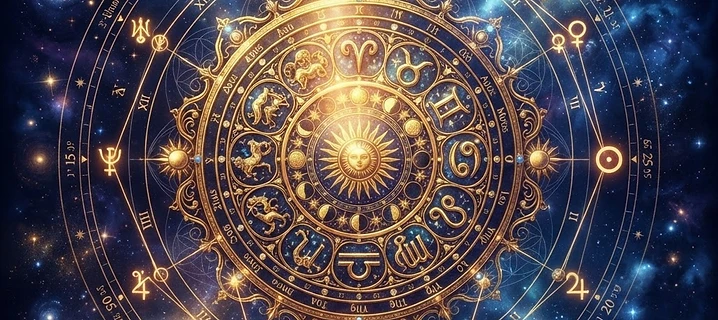
Your progressed chart advances your natal sky — a portrait of who you are becoming.
“The sky at your birth is fixed; the sky within you keeps turning, one quiet day for every lived year.”
More about progressed charts
Q: What is the progressed New Moon?
The progressed New Moon occurs roughly every 30 years when the progressed Sun and progressed Moon conjoin. It marks a major life chapter — the close of one ~29.5-year cycle and the seed of the next. The period around it often feels like a reset or a new beginning.
Q: Can progressions predict specific events?
Progressions describe inner shifts — changing moods, identity, and focus — rather than specific external events. They set the inner weather that makes you receptive to certain experiences. Outer events usually arrive when a transit triggers a progressed theme.