✦ Lithomancy ✦
Stone Casting
Cast the sacred stones and read the pattern they form. Each stone carries a color, a name, and a message.
For entertainment, spiritual reflection, and creative inspiration only. This content is not a substitute for professional medical, psychological, legal, or financial advice. Always consult a qualified professional for important decisions.
Lithomancy reads the future in the fall of stones. Where runes use fixed symbols, lithomancy often lets the stones speak through their colors, positions, and the relationships they form when they land.
What is lithomancy?
Lithomancy is divination by casting stones. The reader tosses a set of marked or colored stones onto a surface and interprets the resulting pattern — where each stone lands, how the stones relate to one another, and the symbols or colors they carry.
Unlike rune casting, which uses the fixed symbols of the Elder Futhark, lithomancy stones may be plain, colored, or marked with the reader's own symbols. The focus is often spatial: the pattern and proximity of the stones tell the story.
A common color-based stone set
| Stone color | Represents |
|---|---|
| White / clear | Purity, clarity, new beginnings |
| Red | Passion, energy, conflict, courage |
| Orange | Vitality, creativity, willpower |
| Yellow | Intellect, communication, joy |
| Green | Growth, healing, abundance |
| Blue | Emotion, intuition, peace |
| Purple | Spirituality, wisdom, the hidden |
| Black | Protection, endings, the unknown |
Reading the pattern
- Note which stones land face-up or face-down — face-up stones are active and present.
- Stones that cluster together represent forces working in concert.
- Stones that land apart or opposite one another suggest tension or opposing influences.
- The stone closest to the caster reflects the most personal, immediate matter.
- Stones near the edge of the field point to influences entering or leaving the situation.
Build your own set
A lithomancy set is deeply personal. Choose thirteen stones (a traditional number) — twelve marked with colors or symbols and one unmarked 'witness' stone that represents the questioner. Cleanse them under moonlight and charge them with your intention.
Lithomancy FAQ
Q: How is lithomancy different from runes?
Runes use the fixed runic symbols of the Elder Futhark. Lithomancy uses stones that may be plain, colored, or marked with any symbols the reader chooses, and often emphasizes the spatial pattern and relationships between stones rather than fixed symbol meanings.
Q: How many stones do I need?
Traditions vary from 3 to 13. A common set uses 13: twelve meaning-stones plus one witness stone for the questioner. Start with a number you can interpret confidently and grow from there.
Q: Can I use any stones?
Yes — river pebbles, tumbled crystals, or painted tiles all work. What matters is that you know each stone's assigned meaning and that the set feels right to you. Consistency matters more than material.
The fall of stones

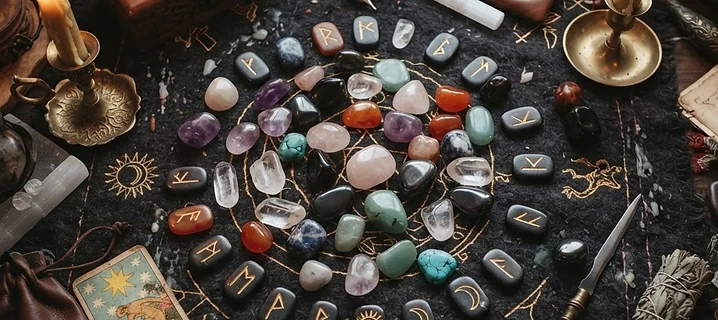
Where each stone lands — and how they relate — tells the story.
“The stones know only where they fall; the reader learns to hear the silence between them.”
More about lithomancy
Q: What is the witness stone?
In many traditions, one stone in the set is left unmarked and represents the questioner. Called the witness or personal stone, it anchors the reading: stones near it reflect matters close to the questioner, while distant stones describe outside influences.
Q: Can I combine lithomancy with crystal meanings?
Yes. If you use tumbled crystals instead of plain stones, you can layer each stone's crystal meaning (rose quartz for love, citrine for abundance, and so on) onto its position in the cast. This enriches the reading but requires you to know each stone's properties well.