✦ Cartomancy ✦
Playing Card Reading
Three cards from an ordinary deck — Past, Present, and Future. The common deck speaks a language older than tarot.
For entertainment, spiritual reflection, and creative inspiration only. This content is not a substitute for professional medical, psychological, legal, or financial advice. Always consult a qualified professional for important decisions.
Past
What has led you to this moment
Present
The energy surrounding you now
Future
The path that lies ahead
Before tarot decks traveled across Europe, fortune-tellers read the ordinary playing card deck — 52 cards, four suits, and centuries of folk meaning. Cartomancy is fast, accessible, and surprisingly deep.
What is cartomancy?
Cartomancy is divination using a standard 52-card playing deck. Each suit governs a domain of life — hearts for emotion and home, diamonds for money and work, clubs for action and conflict, spades for challenge and the intellect. The numbered cards show the unfolding of a situation, while the face cards represent people and personalities.
Because the deck is so common, cartomancy became the people's divination — practiced at kitchen tables without expensive tools. A simple three-card draw (past, present, future) can be read in minutes, while a full spread reveals a layered story.
The four suits and what they govern
| Suit | Domain | Tone |
|---|---|---|
| Hearts ♥ | Love, family, home, friendship | Emotional, nurturing |
| Diamonds ♦ | Money, work, messages, news | Material, practical |
| Clubs ♣ | Action, enterprise, conflict | Energetic, ambitious |
| Spades ♠ | Challenges, intellect, endings | Serious, transformative |
Key card meanings to remember
- Ace of Hearts — a new love, a happy home, an emotional gift.
- Ace of Diamonds — a letter, money, or important news arriving.
- Seven of Hearts — fickle affections, daydreams, wishful thinking.
- Jack of Clubs — a lively young person, a messenger, energy entering.
- Queen of Spades — a powerful, sometimes difficult woman; keep secrets.
- King of Hearts — a kind, fair man; emotional support and protection.
Red vs. black
A spread dominated by red cards (hearts and diamonds) tends toward pleasure, gain, and social warmth. A spread heavy in black cards (clubs and spades) signals effort, obstacles, or matters that require strategy and patience — not necessarily bad luck.
Cartomancy FAQ
Q: How is cartomancy different from tarot?
Cartomancy uses a standard 52-card playing deck, while tarot uses a 78-card deck with Major and Minor Arcana. Cartomancy is simpler and faster, ideal for quick guidance. Both are tools for reflection; neither is more 'powerful' than the other.
Q: Do I need a special deck?
Any ordinary playing card deck works. Some readers prefer a deck used only for divination so it absorbs the energy of the practice, but it is not required. Cleanse a new deck by shuffling it with your intention in mind.
Q: What spread should beginners use?
Start with a three-card spread: past, present, future. It is easy to interpret and covers the arc of a situation. As you grow comfortable, try the nine-card or the full thirty-six-card spreads for more detail.
The people's deck

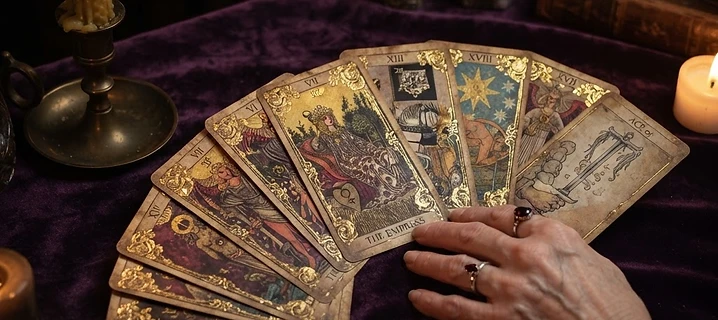
A standard 52-card deck — the most accessible divination tool in the world.
“Fifty-two cards, four suits, one story: the deck speaks plainly to those who learn its simple language.”
More about cartomancy
Q: Where do playing-card meanings come from?
Cartomancy meanings blend numerology, suit symbolism, and centuries of folk tradition. The suits trace to the four classes of medieval society in some systems, while the numbers carry numerological weight from Pythagorean and folk sources.
Q: Should I read reversed cards differently?
Some cartomancers read reversals (upside-down cards) as blocked or inverted meanings; others ignore orientation entirely. There is no fixed rule. Choose one approach and apply it consistently so your readings stay coherent over time.